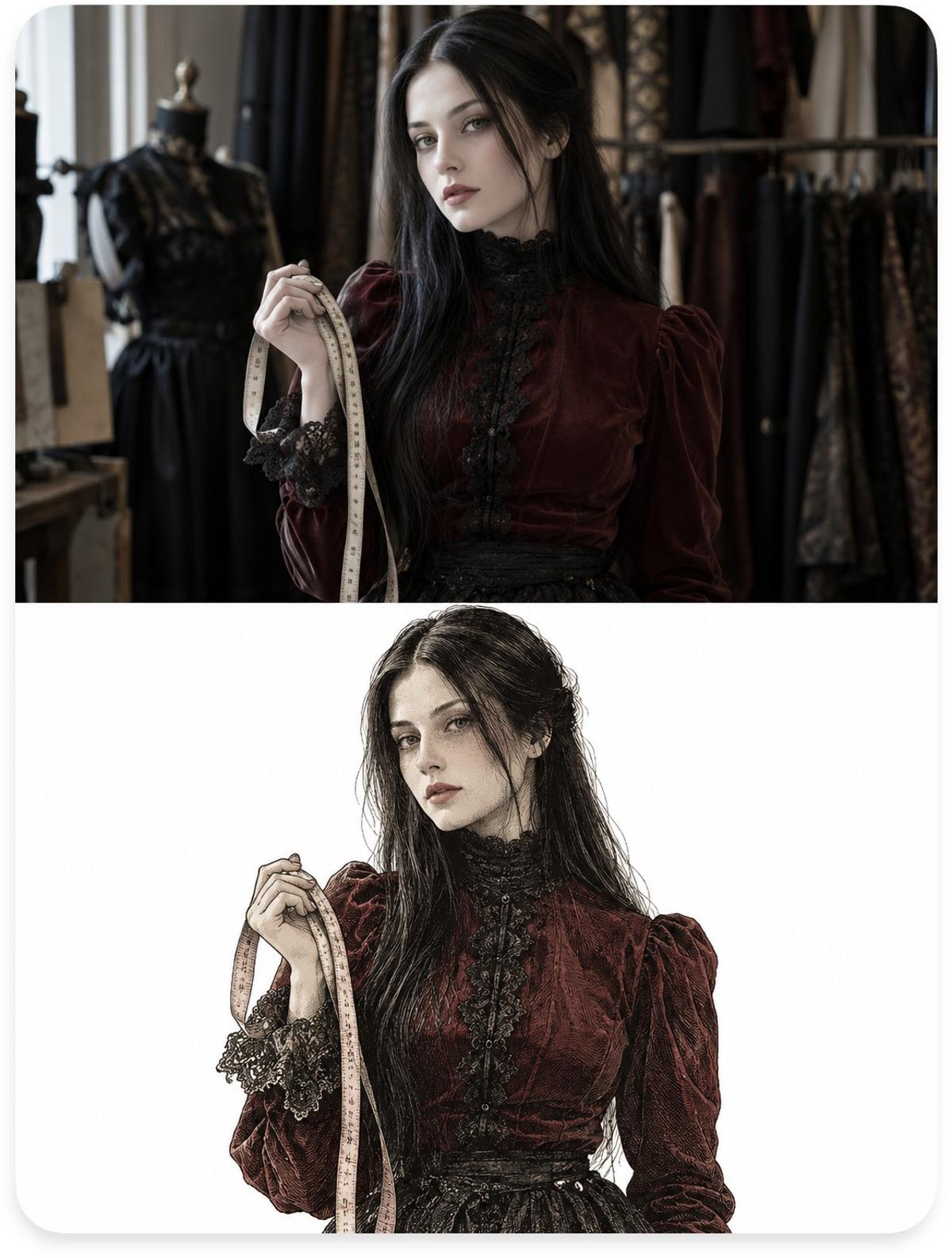
Victorian Gothic Portrait and Pet Diptych
0
0
0
0
Prompt
Prompt (English)
[Composition and original photograph] Generate one vertical 3:4 diptych with two panels stacked vertically, approximately equal in height. The input is a reference photograph of a single person or a single pet. The upper panel directly displays the original input photograph, preserving its subject, pose, expression, clothing and accessories, background, and lighting. Only scale it proportionally and place it; add white padding if the proportions do not fit. Do not stretch, redraw, or crop out key content. The lower panel presents only a stylistic translation of the same subject, against a pure white #FFFFFF background, centered with a stable visual focus and breathing room; do not copy the photographic background. If the photograph is a half-body shot or close-up, use the same framing below and fully contain the subject within that framing; do not force it into a full-body view. If the photograph shows the whole body, preserve the entire body below.

[Lower panel | Victorian Gothic translation] Create an illustration in the visual language of “Victorian Gothic”: retain an aged-paper feel, slight fading, traditional print grain, and period decorative details. Establish the style through a somber mood, sharp contours, classical ornament, fine engraved lines, and dark fabrics, with rich detail and a clear visual focus. For people, preserve the original face shape, facial features, hairstyle, pose, and main clothing structure. Translate the existing neckline, cuffs, and fabric details into Victorian high collars, lace, subtle patterns, and fine engraving. Clothing may be stylized, but its original main color relationships and key accessories must remain recognizable; do not arbitrarily replace the subject with an unrelated character in formal dress. For animals, preserve species, coat color, markings, ear shape, and expression. Render fur with fine engraved lines and vintage print grain. Add only a little lace or classical patterning to a collar already present in the photograph; do not put the animal in a human long dress or add hats or wings. Use restrained colors such as charcoal black, ink gray, deep burgundy, and small amounts of antique gold, while retaining corresponding key colors from the original photograph. Confine aged-paper and faded textures to the subject itself. Keep the somber quality within the subject: do not introduce a dark background, castle, or cemetery, and do not add gore. The background must always remain pure white.

[Middle transition] At the top edge of the lower panel, use a subtle aged-paper edge and rhythmic engraved lines for the transition. Keep all textures in the lower panel, leave the upper photograph unchanged, and do not use a thick black horizontal line.

[Consistency and restrictions] For people, preserve face shape, relationships between facial features, hairstyle silhouette, skin tone or its clear stylistic equivalent, clothing structure, accessories, pose, and expression. For animals, preserve species, ear shape, eyes, nose and mouth, coat-color regions, direction of markings, body shape, and collar. Proportional, material, and form translations required by the selected style are allowed, but the same subject must remain recognizable in both panels. The image should feel natural and handmade. Lines, color areas, light and shade, materials, and textures must serve the same style. Avoid excessive smoothness, meaningless accumulations of detail, random decoration, incorrect limbs, extra subjects, and mixed styles. Apart from text already present in the input photograph, do not add any text, letters, numbers, slogans, logos, brand names, watermarks, borders, or UI. Remove text and logos from the reference photograph in the lower panel. Generate only one complete diptych containing both panels each time. Do not generate a multi-subject example collage, and do not combine the human and pet versions into one image and then crop them apart.
Prompt (Chinese)
【构图与原图】生成一张3:4竖版上下双拼图,上下区域高度约1:1。输入为单个人物或单只宠物的参考照片。上半部分直接呈现输入原图,保持照片里的主体、姿态、神态、服装配饰、背景与光线;仅等比缩放安放,比例不合时补白,不拉伸、不重新绘制、不裁掉关键内容。下半部分只呈现同一主体的风格转译,纯白背景#FFFFFF,主体居中、视觉中心稳定、留有呼吸空间,不复制照片背景。照片是半身或近景时,下方对应同样的取景范围,完整容纳该范围内的主体,不硬补全身。照片是全身时,下方完整保留全身。

【下半部分|维多利亚哥特转译】创作「Victorian Gothic」视觉语言的插画:保留旧纸感、轻微褪色、传统印刷颗粒和时代化装饰细节,以阴郁气质、尖锐轮廓、古典装饰、细密线刻和深色织物建立风格,细节丰富但视觉中心明确。人物保留原脸型、五官、发型、姿态和主要衣着结构,将既有领口、袖口与织物细节转译为维多利亚高领、蕾丝、暗纹和细致线刻;服装可作风格化处理,但原有主色关系和关键配饰仍可识别,不凭空换成完全无关的礼服角色。动物保留物种、毛色、花纹、耳形与神态,毛发用细密线刻与复古印刷颗粒表达;仅在照片已有项圈上转译少量蕾丝或古典纹样,不穿人类长裙、不添加帽子或翅膀。采用炭黑、墨灰、深酒红及少量旧金等克制色彩,同时保留原图关键色的对应。旧纸与褪色纹理限定在主体内部,阴郁气质留在主体,不铺陈暗背景、古堡或墓地,不加血腥元素,背景始终纯白。

【中间衔接】下半区顶端以细微旧纸边和线刻节奏衔接,所有纹理留在下方,不修改上半照片,不用粗黑横线。

【一致性与限制】人物保留脸型、五官关系、发型轮廓、肤色或其明确的风格化对应、服装结构、配饰、姿态与神态;动物保留物种、耳形、眼睛、鼻口、毛色分区、花纹走向、体型与项圈。允许所选风格需要的比例、材质和形体转译,但上下必须能认出同一主体。画面自然、有手作感,线条、色块、明暗、材质与纹理服务于同一风格,避免过度光滑、无意义细节堆砌、随机装饰、错误肢体、额外主体和混杂画风。除输入原图本来存在的文字外,不新增任何文字、字母、数字、标语、Logo、品牌名称、水印、边框或UI;下半部分去除参考图中的文字和Logo。每次只生成一张含上下两区的完整双拼图,不生成多主体示例拼图,不把人物版和宠物版拼在一起再裁切。
Parameters
GGPT Image
3:4
○○○○○
—
—
—
Comments
to join the conversation