Photo and handmade fuse bead charm posters
0
0
0
0
Prompt
Prompt (English)
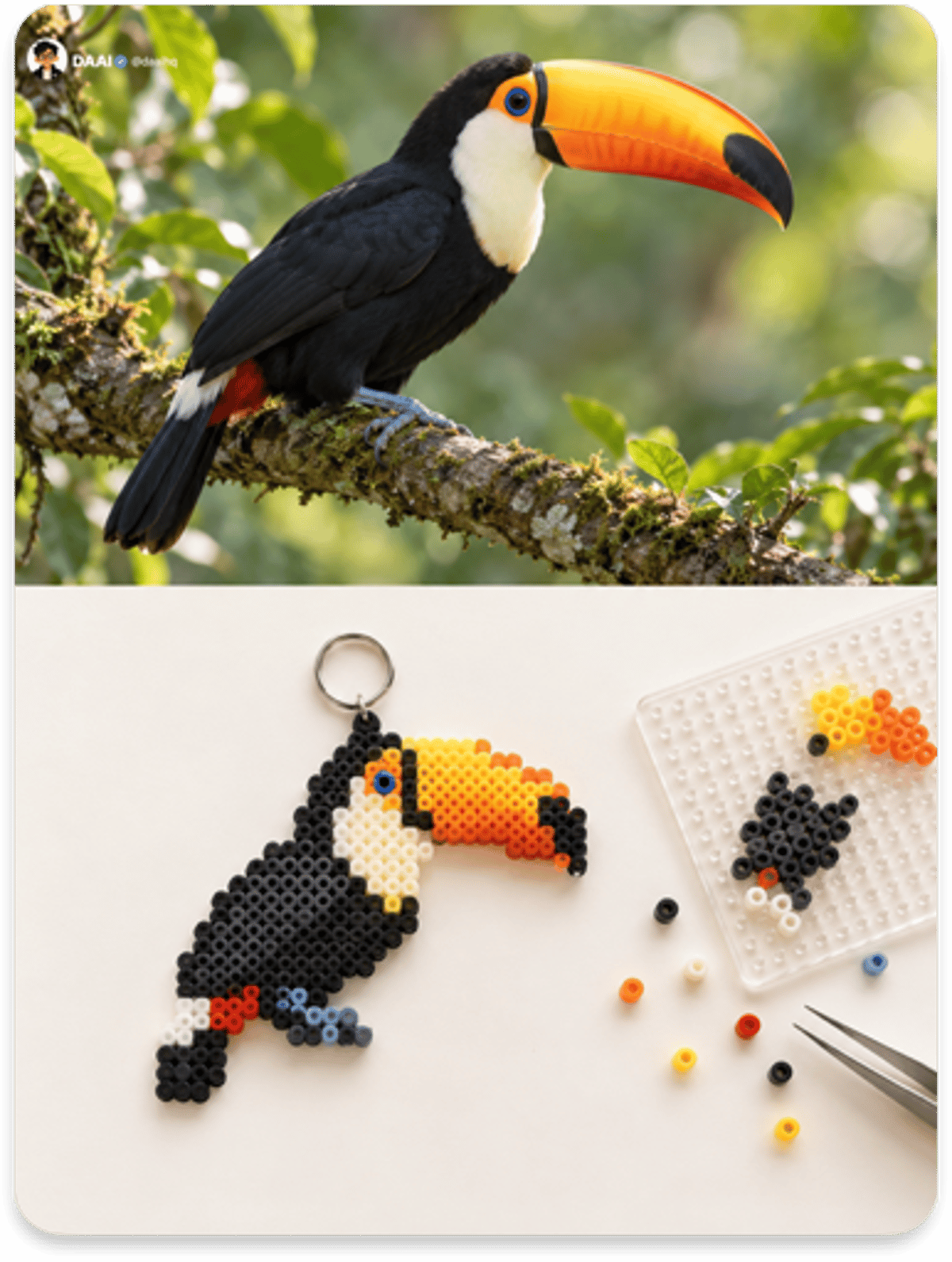
Please turn each photo I upload into its own independent, premium design poster. Do not combine multiple photos; output each photo separately. Use an overall 3:4 vertical composition, with the upper and lower areas strictly equal in height, each occupying 50% of the image.

Keep the original photo in the upper half, preserving the subject's identity, structure, pose, realistic texture, natural light and shadow, and original color atmosphere. Apply only subtle, refined color grading for the feel of an art magazine or lifestyle publication. To fit the frame, the surrounding background may be extended naturally, but the subject must not be stretched, distorted, or altered.

In the lower half, extract the photo's most recognizable **subject, silhouette, and color relationships**, and condense them into a low-pixel **fuse bead artwork / fuse bead pixel object**. Build the subject from approximately 20×20 to 30×30 small colored beads, with a simplified outline and minimal detail, using a few key colors to make the original object instantly recognizable. The finished piece should resemble a little keychain charm or a treasured handmade badge.

The visual narrative has two layers: a finished, ironed bead piece with slightly fused edges, and beside it an unfinished section on a transparent pegboard, a few scattered beads, and a small pair of tweezers, as if the maker has just paused. Limit supporting objects to two at most; keep it restrained.

Emphasize the authentic material qualities of fuse beads: each bead's hollow center, slight fusion and flattening after ironing, a softly semi-matte surface, imperfect granular edges and slight warping, and soft, short shadows cast onto a solid-colored background. Avoid flat digital pixel fills, the feel of a game screenshot, and the excessive smoothness of 3D plastic rendering.

Use an overhead still-life composition. The finished piece is the primary focal point, occupying only about 30%–35% of the lower half, forming a loose, asymmetrical balance with the pegboard and scattered beads. Keep the background an **extremely pale solid color** (cream white, pale mint, pale pink-white, or pale mist blue), leaving abundant negative space.

Extract the 4–6 brightest, most vivid colors from the photo above and translate them into the cheerful colors typical of fuse beads: brighter, purer, and less gray; fresh and soothing, neither cheap-looking nor fluorescent.

Introduce text sparingly: perhaps a small handwritten label, a number, or a short word, placed quietly in the negative space, with no restriction on language.

The overall image should feel light and cheerful through a combination of **bead pixels, iron-fused beads, the handmade process, overhead still life, and abundant negative space**. The core principle: pixels do not have to glow; they can also be little beads pressed into a pegboard by hand. Avoid video-game pixel art, edge-to-edge bead coverage, a cheap plastic toy look, fluorescent colors, a cartoon feel, and formulaic product photography.
Prompt (Chinese)
请将我上传的每一张照片分别制作成一张独立的高级设计海报,不多图拼接,每张照片单独输出。整体采用 3:4 竖版构图,上下两个区域高度严格 1:1,各占画面 50%。

上半部分保留原始照片,保持主体身份、结构、姿态、真实质感、自然光影与原有色彩氛围,仅进行轻微高级调色,使其具有艺术杂志与生活方式出版物质感。为适配画幅,可自然扩展环境背景,但不得拉伸、扭曲或改变主体。

下半部分提取照片中最具识别性的**主体、轮廓与色彩关系**,压缩为一枚低像素的**拼豆作品 / fuse bead pixel object**。主体用约 20×20 到 30×30 颗彩色小豆完成,轮廓概括、细节极简,依靠少量关键颜色让人一眼认出原物。成品像一枚可以挂在钥匙上的小挂件,或一枚被珍藏的手作徽章。

画面叙事分为两层:一枚已经熨烫完成、边缘微微融合的成品拼豆作品,以及旁边一块透明钉板上还未完成的局部、少量散落的小豆与一把小镊子,像手作者刚刚停下来。辅助物最多两件,保持克制。

材质强调拼豆的真实质感:每一颗小豆的中空小孔、熨烫后的轻微融合与压平、表面的柔和半哑光、边缘不完美的颗粒轮廓与轻微翘曲,以及在纯色背景上投下的柔和短影。避免数码像素平涂、游戏截图感和 3D 塑料渲染的过度光滑。

构图采用俯拍静物视角,成品作品为第一视觉焦点,只占下半部分约30%–35%,与钉板和散豆形成松散的非对称平衡,背景保持**极浅纯色**(奶油白、浅薄荷、浅粉白或浅雾蓝),保留大量负空间。

配色从上方照片中提取最明亮、最鲜活的 4–6 种颜色,转化为拼豆常见的明快颜色:提亮、提纯、去灰,清爽治愈,不廉价、不荧光。

文字少量介入,可以是一张手写小标签、一个编号或一个短词,安静落在留白中,不限制语种。

整体呈现**拼豆像素、熨烫融合、手作过程、俯拍静物与大量留白**共同构成的轻快视觉。核心原则是:像素不一定发光,也可以是一颗颗被手按进钉板里的小豆子。避免游戏像素风、满版拼豆、廉价塑料玩具感、荧光色、卡通感和模板化商品图。
Parameters
3:4
○○○○○
—
—
—
Comments
to join the conversation