Diaphonized Marine Fish Natural-History Field Guide
0
0
0
0
Prompt
Prompt (English)
Marine fish × diaphonized transparent skeletal specimens × modern natural-history field guide × popular-science editorial

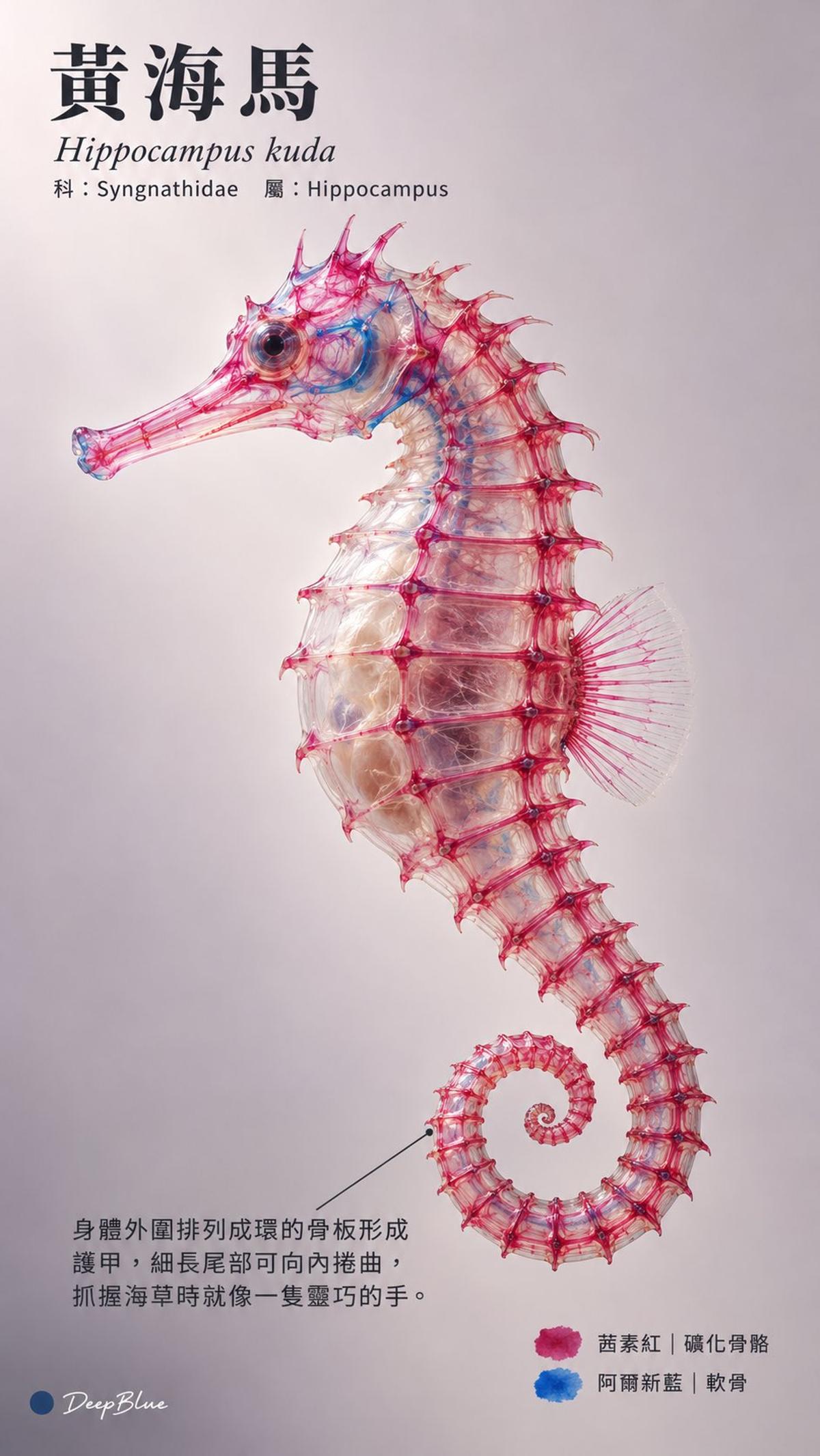
Randomly select 10 different species of marine bony fish, with one complete specimen per image. Independently vary body posture, viewing angle, composition, and direction of transmitted light in each image to show different body shapes and skeletal structures.

Soft tissues are almost transparent, faintly retaining the external contours and soft volume. Alizarin red reveals mineralized bone, and Alcian blue reveals cartilage; staining distribution varies naturally with the species and degree of ossification. The skeleton conforms to the species' anatomy and is naturally articulated. A transparent glycerin-preserved texture, with transmitted light revealing intricate structures and front-to-back depth; realistic macro specimen photography.

Use a consistent field-guide information grid: the Chinese name, italic Latin scientific name, and family/genus classification at the top; the complete specimen in the middle; and a 30–50-character introduction at the bottom describing one interesting feature observable in the image, with fine leader lines pointing to the relevant part when necessary, plus a short red/blue staining legend. Use accurate Traditional Chinese throughout. Verify that the names, scientific names, classifications, and features all correspond to the species.

Use a Source Han Serif-style typeface for Chinese names, a Source Han Sans-style typeface for descriptions, and a Western serif italic typeface for Latin scientific names. When a name contains rare characters, easily misread characters, or polyphonic characters, place the Hanyu Pinyin for the complete name beneath it in small, clear sans-serif type, with accurate tones and pronunciation, adequately separated from the Latin scientific name; omit Pinyin for common, easily read names.

Extract coordinating background colors from the specimen's red/blue staining, reducing saturation and increasing lightness to create chromatic grays such as pale gray-blue, gray-pink, or gray-purple, preserving differences in lightness and color between the skeleton and background. An extremely subtle transmitted-light gradient may appear near the specimen; keep the text areas evenly toned, with deep charcoal text for clear reading. Keep background lightness and saturation similar across the set, with hue varying by subject.

Clear type-size hierarchy, left-aligned text, generous margins, and no overlapping of images and text. Adjust each layout to the fish's shape while maintaining visual consistency across the set.

9:16 portrait format, n=10, 10 independent single images, no collage. At the lower left of each image, a small solid dark-blue dot, followed by a space and “DeepBlue” in white handwritten lettering.
Prompt (Chinese)
海洋魚類 × Diaphonization 透明骨骼標本 × 現代自然史圖鑑 × 科普 Editorial

隨機選取10種不同的海洋硬骨魚,每張一件完整標本。各張獨立變化體態、觀看角度、構圖與透光方向,展現不同體形與骨架結構。

軟組織近乎透明,隱約保留體表輪廓與柔軟體積。茜素紅顯示礦化骨骼,阿爾新藍顯示軟骨,染色分布依物種與骨化程度自然變化。骨架符合物種解剖,自然連接。透明甘油浸存質感,透射光顯露精密結構與前後層次,真實微距標本攝影。

沿用統一的圖鑑資訊網格:上方為中文名、斜體拉丁學名與科屬分類;中間完整展示標本;下方以30至50字介紹一個可從圖中觀察的有趣特徵,必要時用纖細引導線對應部位,另附簡短紅藍染色圖例。中文統一使用準確繁體字,名稱、學名、分類與特徵均經核對並對應物種。

中文名採思源宋體風格,說明採思源黑體風格,拉丁學名採西文襯線斜體。名稱含生僻字、易讀錯字或多音字時,在其下方以小字標示完整名稱的漢語拼音,聲調與讀音準確,採清晰無襯線字體,與拉丁學名適度分隔;常見易讀名稱省略拼音。

背景從標本紅藍染色中提取呼應色,降低飽和度、提高明度,形成淡灰藍、灰粉或灰紫等有彩灰色,保留骨架與背景的明暗及色彩差異。標本附近可有極輕微透光漸變,文字區域色調均勻,以深炭色文字保持清晰閱讀。整套背景明度與飽和度接近,色相隨主體變化。

字級層次清晰,文字左對齊,邊距充足,圖文互不遮擋。各張依魚形調整版面,保持整套視覺一致。

9:16豎版,n=10,10張獨立單圖,不拼圖。每張左下角小尺寸深藍色實心圓點,空格後接白色手寫體「DeepBlue」
Parameters
GGPT Image 2.5
9:16
○○○○○
—
—
—
Comments
to join the conversation