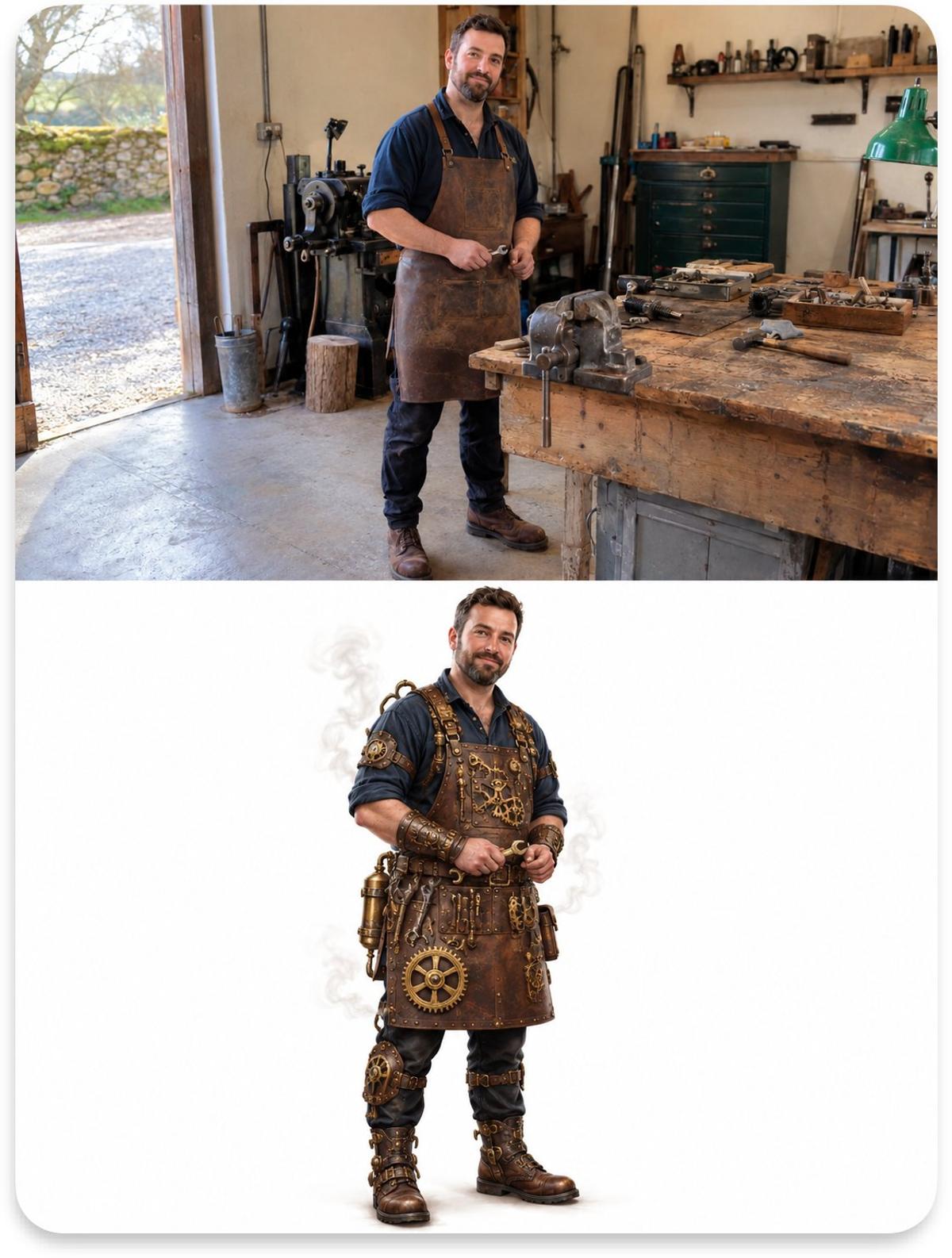
Steampunk Subject Transformation in Stacked Panels
0
0
0
0
#IllustrationGGPT Image
Prompt
Prompt (English)
[Overall composition]
Generate a standalone 3:4 vertical image split into two stacked panels, with their heights approximately 1:1. The upper panel shows only the uploaded original photograph or original image, and the lower panel shows only a stylistic reinterpretation of the same subject. The entire image contains only one subject: do not add a second subject, unrelated settings, a side-by-side arrangement of a person and a pet, or a third panel. Both the original and the stylized subject occupy the stable visual center of their respective panels. Leave an appropriate safe margin below.

[Upper panel | Original image]
The uploaded image is the sole basis for the subject's identity, structure, and pose. Preserve the original photographic or imaging texture, natural light, setting, colors, and real materials. Do not redraw the original or apply an artistic filter to it. Prefer embedding the entire original image, using blank space to complete the layout. If cropping is necessary, crop only irrelevant background; do not remove key identifying features, change the subject's proportions, or change its pose. Preserve the subject's silhouette, structure, color divisions, material characteristics, accessories, props, gaze, orientation, and pose. No effects from the lower panel may cover the original image above.

[Lower panel | Correspondence to the subject]
Reinterpret only the original image's main subject and its actually present carried props or attached structures; change the background to pure white. Maintain the same viewpoint, orientation, gaze direction, and corresponding pose. If the original is a detail or half-length composition, prioritize the corresponding framing below; if it shows the whole body or complete subject, retain the complete subject below, without arbitrarily changing its pose to fill the frame. Style may change proportions, materials, and structure, but identifying characteristics must remain continuous. Do not replace the subject or change its identity, species, category, apparent age, color divisions, or core structure. Do not forcibly anthropomorphize a nonhuman subject.

[Lower panel | Core steampunk style]
Present brass machinery, gears and pipes, Victorian clothing, and steam-industrial details. Use brass gold, dark brown leather, the original image's main colors, and warm off-white. Reinterpret the subject's existing clothing, accessories, tools, or structures as Victorian mechanical components with plausible functions. Brass gears, rivets, valves, and pipes appear only where functionally justified, with clearly defined axles, hinges, straps, and connection points; do not randomly cover the subject with gears. Leather should show natural wear, brass should have restrained oxidation and reflections, and linework and shading should consistently follow a finely handcrafted illustration style. Animals, plants, objects, and other subjects retain their own category, structure, and proportions; reinterpret only their existing attached structures as lightweight leather-and-brass components, without turning them into humanoid mechanical characters. The subject must remain complete, and industrial details must not obscure its silhouette. Keep the background pure white. Use only a small amount of steam near mechanical components, without a factory setting. Exclude black-and-white photocopy effects, graffiti, torn paper, neon, and useless accumulations of machinery.

[Centerline and transition]
Place a small amount of light, thin steam near the centerline in the lower panel, without obscuring the original image. The transition serves only to help viewers see the correspondence between the upper and lower panels. Do not use a thick black horizontal line, let the subject merge across the line, or fuse the two representations into a single subject.

[Unified quality and text rules]
The upper and lower panels must be immediately recognizable as the same subject, and the lower panel must clearly reconstruct the style rather than filter the original image. Linework, color blocks, shading, materials, and handcrafted details must consistently serve the same style, without unrelated art styles. Avoid excessive smoothness, meaningless accumulations of detail, random decoration, extra structures, duplicate subjects, and incorrect proportions. Do not add text, letters, numbers, slogans, logos, brand names, watermarks, borders, or recognizable interface text anywhere in the image. If the upper original image already contains text, do not alter it. For this test, choose a new original image with text-free clothing, unbranded props, and a text-free background from the outset. Do not copy readable text from the original image into the lower panel.
Prompt (Chinese)
【整体构图】
生成一张独立的3:4竖版上下双拼图片,上下区域高度约1:1。上方仅展示上传的原照片或原始影像,下方仅展示同一个主体的风格转译。整张图片只包含一个主体,不增加第二个主体、不加入无关场景、不制作人物与宠物并列画面,也不增加第三个画面。原图与风格化主体均位于各自区域的稳定视觉中心,下方保留适当安全边距。

【上半部分|原图】
上传图是唯一的主体身份、结构与姿态依据。保留原图原有的摄影或影像质感、自然光线、场景、色彩和真实材质,不重绘原图,不为原图施加艺术滤镜。优先完整嵌入原图,以留白补齐版面;如需裁切,只能裁切无关背景,不能切掉关键识别点、改变主体比例或改变姿态。必须保留主体的轮廓、结构、颜色分区、材质特征、配饰、道具、视线、朝向和姿态。下半部分的任何特效都不得覆盖上方原图。

【下半部分|主体对应】
只转译原图中的核心主体及其实际存在的随身道具或附属结构,背景改为纯白。保持相同视角、朝向、视线方向和对应姿态;原图为局部或半身构图时,下方也优先采用对应范围;原图为全身或完整主体时,下方保留完整主体,不为填满画面而随意改变姿势。允许因风格改变比例、材质和结构,但主体辨识特征必须连续。不得替换主体、改变其身份、物种、类别、年龄感、颜色分区或核心结构,不得将非人主体强行拟人化。

【下半部分|蒸汽朋克核心风格】
呈现黄铜机械、齿轮管道、维多利亚服饰和蒸汽工业细节。采用黄铜金、深棕皮革、原图中的主要颜色与暖米白色。主体原有的服装、配件、工具或结构转译为具有合理功能的维多利亚式机械部件。黄铜齿轮、铆钉、阀门和管道只出现在具有功能依据的位置,明确轴、铰链、扣带与连接点,不随意把齿轮贴满主体。皮革应有自然磨损,黄铜呈现克制的氧化与反射,线条和明暗统一为精细手作插画。动物、植物、物品及其他主体保留自身类别、结构和比例,仅将原有附属结构转译为轻巧的皮革黄铜部件,不变成人形机械角色。主体必须完整,工业细节不得遮挡轮廓。背景纯白,蒸汽仅在机械部件附近少量出现,不铺设工厂场景。排除黑白复印、涂鸦、撕纸、霓虹和无用机械堆砌。

【中线与过渡】
在下方靠近中线处安排少量轻薄蒸汽,不遮挡原图。过渡仅用于辅助观看上下对应关系,不使用粗黑横线,不让主体跨线混合,也不把两种表现熔合成一个主体。

【统一质量与文字规则】
上下必须一眼认出是同一个主体,下方必须是明确的风格重构,而不是原图滤镜。线条、色块、明暗、材质与手作细节统一服务于同一风格,不混入无关画风。避免过度光滑、无意义的细节堆砌、随机装饰、额外结构、重复主体和比例错误。整张图片不得新增文字、字母、数字、标语、Logo、品牌名、水印、边框或可识别的界面文字。若上方原图本身含有文字,不得涂改原图;本次测试使用的新原图应从源头选用无文字服装、无品牌道具和无字背景。下方不得复制原图中的可读文字。
Parameters
GGPT Image
3:4
○○○○○
—
—
—
Comments
to join the conversation